Best Pickleball Balls of 2026: Indoor, Outdoor & Value Picks
The paddle gets picked first, but the ball decides how the game actually plays. Outdoor and indoor pickleballs are not interchangeable: different hole counts, different plastics, different bounce on different surfaces, and tour players never mix them up.
I researched the outdoor ball that shows up in tournament play, the indoor ball built for gym floors, and a bulk-pack option worth keeping on hand for practice and league night, then ranked the ones that make sense for regular players instead of just tournament directors buying by the case.
Top Picks at a Glance
- Best Overall Selkirk Pro S1 See Current Options →
- Best Outdoor Franklin X-40 ~$10 Check Price →
- Best Indoor Gamma Photon ~$22 Check Price →
- Best Value / Bulk Pack GoSports GS 40 ~$20 Check Price →
- Best for Beginners Onix Recruit ~$9 Check Price →
- Best for Competitive Play Life Time LT Pro 48 ~$50 Check Price →
- Best Budget Buy Amazon Basics Outdoor ~$7 Check Price →
- Best for Night Play Franklin Glow in the Dark ~$10 Check Price →
- Also Great for Indoor Franklin X-26 Indoor ~$10 Check Price →
- Best for Windy Conditions Onix Pure 2 ~$17 Check Price →
- Also Great for Tournament Play Dura Fast 40 ~$18 Check Price →
- Best for Cold Weather JOOLA Primo ~$150 Check Price →
- Best Eco-Friendly Magicorange Recycled ~$27 Check Price →
- Best for Ball Machines & Clubs Vulcan VPRO Flight ~$224 Check Price →
- Also Great for Precision Play JOOLA HC-40 Hardcourt ~$100 Check Price →
- Best for Spin Training GAMMA Two-Tone Training Ball ~$15 Check Price →
- Best Softer Feel Penn 40 Outdoor ~$15 Check Price →
- Best Quiet Ball GAMMA Librarian Foam ~$13 Check Price →
- Best Textured Ball CORE PRO2 Outdoor ~$10 Check Price →
- Best High-Visibility Indoor Ball HEAD Championship 26 Indoor ~$9 Check Price →
- Also Great for Outdoor Onix Fuse G2 Outdoor ~$17 Check Price →
- Best 12-Pack for Groups Tourna Strike Outdoor ~$11 Check Price →
- Also Great for Quiet Practice GoSports GS 40 Q-Foam ~$13 Check Price →
- Best Indoor for Mixed-Skill Groups Penn 26 Indoor ~$14 Check Price →
Side-by-Side Comparison
| Ball | Price | Indoor/Outdoor | Material | Best For | Rating |
|---|---|---|---|---|---|
| Selkirk Pro S1 | Indoor/Outdoor | Polyethylene, 38-hole | Versatile play on any court | 4.6 / 5 | |
| Franklin X-40 | ~$10 | Outdoor | Polyethylene, 40-hole | Tournament and league play | 4.7 / 5 |
| Gamma Photon | ~$22 | Indoor | Soft plastic, 26-hole | Gym floors, quieter play | 4.4 / 5 |
| GoSports GS 40 | ~$20 | Outdoor | Polyethylene, 40-hole | Practice, drilling, keeping extras on hand | 4.3 / 5 |
| Onix Recruit | ~$9 | Indoor | Plastic, precision-drilled | New players, casual indoor games | 4.5 / 5 |
| Life Time LT Pro 48 | ~$50 | Outdoor | 2-piece polymer, 48-hole | Competitive league and tournament play | 4.6 / 5 |
| Amazon Basics Outdoor | ~$7 | Outdoor | Polyethylene, 40-hole | Lowest-cost reliable pick from a trusted brand | 4.4 / 5 |
| Franklin Glow in the Dark | ~$10 | Outdoor | Polypropylene, one-piece molded | Evening games and backyard play after dark | 4.3 / 5 |
| Franklin X-26 Indoor | ~$10 | Indoor | EVA plastic, 26-hole | A second indoor option with a color players track differently than orange | 4.3 / 5 |
| Onix Pure 2 | ~$17 | Outdoor | Weighted plastic, precision-drilled | Gusty, wind-prone outdoor courts | 4.5 / 5 |
| Dura Fast 40 | ~$18 | Outdoor | Plastic, 40-hole, one-piece molded | High-level tournament and league play | 4.4 / 5 |
| JOOLA Primo | ~$150 | Indoor/Outdoor | Polyethylene, 40-hole, rotomolded | Cold-weather outdoor play, stocking a full case | 4.4 / 5 |
| Magicorange Recycled | ~$27 | Outdoor | Recycled polypropylene, 40-hole | Eco-conscious players who still want tournament-style bounce | 4.5 / 5 |
| Vulcan VPRO Flight | ~$224 | Outdoor | Resin, 40-hole | Ball machines, clubs, and coaches buying in bulk | 4.4 / 5 |
| JOOLA HC-40 Hardcourt | ~$100 | Indoor/Outdoor | Proprietary polymer, 40-hole equidistant | Precision-focused players training like the pros | 4.5 / 5 |
| GAMMA Two-Tone Training Ball | ~$15 | Outdoor | Hard plastic, 40-hole | Seeing and drilling spin during practice | 4.3 / 5 |
| Penn 40 Outdoor | ~$15 | Outdoor | Plastic, 40-hole, precision-drilled | Recreational and club players who want a gentler bounce | 4.5 / 5 |
| GAMMA Librarian Foam | ~$13 | Both | Solid foam, no holes | Noise-restricted courts, HOAs, and home practice | 4.3 / 5 |
| CORE PRO2 Outdoor | ~$10 | Outdoor | Textured plastic, 40-hole, injection-molded | Touch players who want more feel on drops and resets | 4.3 / 5 |
| HEAD Championship 26 Indoor | ~$9 | Indoor | Plastic, 26-hole, red | Gym and wood-floor players who lose a yellow ball against the background | 4.3 / 5 |
| Onix Fuse G2 Outdoor | ~$17 | Outdoor | Seam-welded plastic, 40-hole | Rec and club players who want a proven outdoor ball with a true bounce | 4.4 / 5 |
| Tourna Strike Outdoor | ~$11 | Outdoor | Plastic, 40-hole, mid-range hardness | Families, groups, and weekly games that go through a dozen balls a season | 4.3 / 5 |
| GoSports GS 40 Q-Foam | ~$13 | Indoor/Outdoor | High-density foam, 22g | Home wall drills and noise-sensitive courts on a budget | 4.2 / 5 |
| Penn 26 Indoor | ~$14 | Indoor | Plastic, 26-hole, softer feel | Rec center and open-play gyms where beginners and stronger players share a court | 4.2 / 5 |
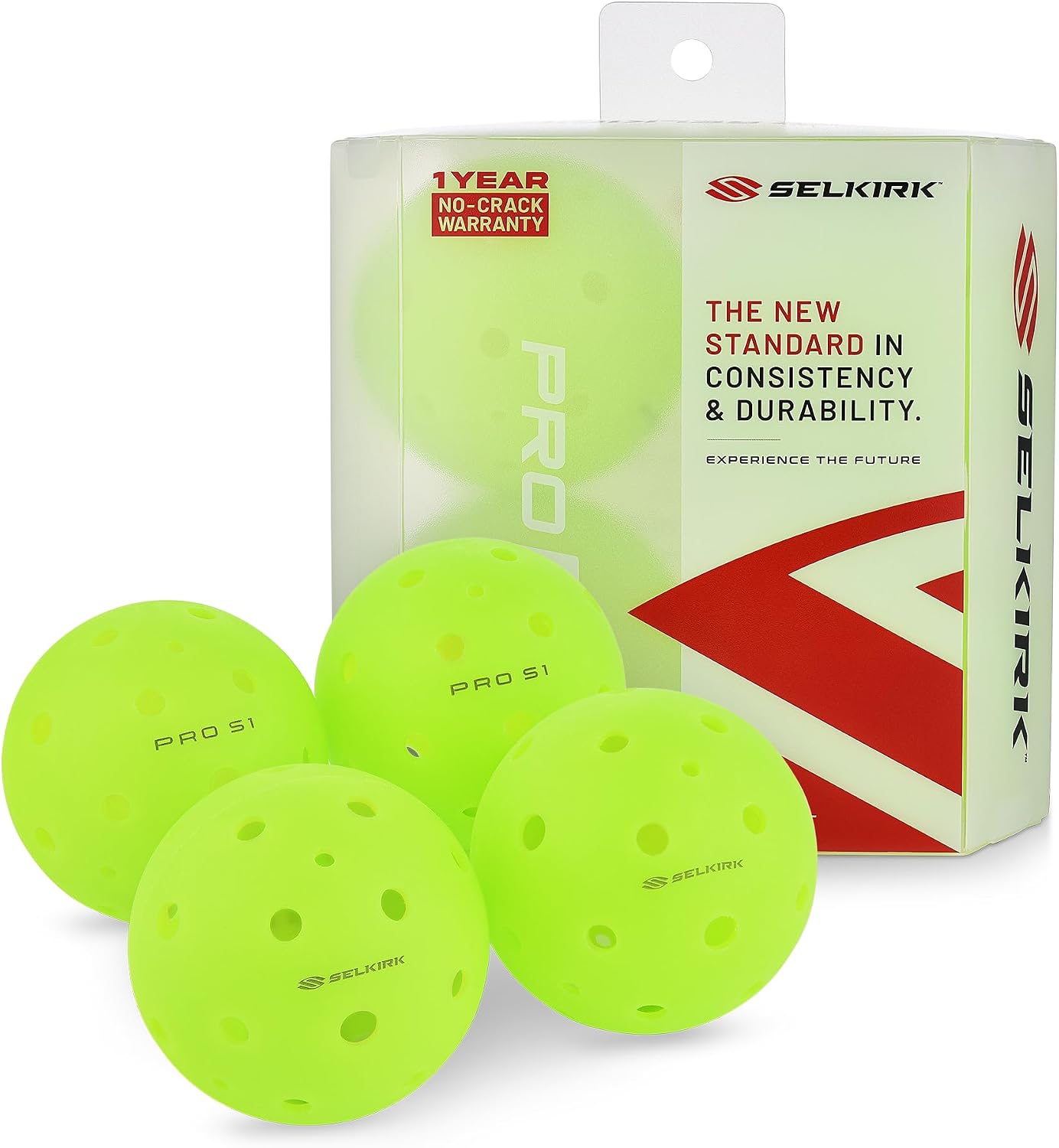
The Pro S1 is the one ball in this roundup built to work on both sides of the net: USAPA approved and genuinely playable indoors or outdoors, so you are not stuck buying two different balls for two different courts. Seamless rotomolded construction keeps every ball round and consistent from the first serve, and Selkirk backs it with a 1-year no-crack warranty most bulk-pack balls do not offer. It is the pick for a player who wants one ball that handles wherever they end up playing this week.
Pros
- USAPA approved and genuinely playable both indoors and outdoors
- 1-year no-crack warranty, longer than most balls in this roundup offer
- Seamless rotomolded build stays round and consistent over time
- Widely reviewed with a large, well-established rating base
Cons
- Firmer feel takes some adjustment if you are used to a softer ball like the Onix Recruit
- Check the warranty terms if you play heavily outdoors, in case balls crack early

The X-40 is the ball you will actually see at a sanctioned tournament: it is the official ball of the US Open and USA Pickleball's own sanctioned events, and that is not a marketing line, it is who is using it on the pro side. Forty machine-drilled holes keep flight consistent from ball to ball, and the one-piece construction holds up to outdoor asphalt and concrete far longer than a softer indoor ball would. If you only buy one type of ball, this is the one league play and outdoor courts expect.
Pros
- Official ball of the US Open and USA Pickleball sanctioned play
- 40 machine-drilled holes for consistent, balanced flight
- Durable one-piece build holds up to outdoor surfaces
- Widely available in multiple pack sizes
Cons
- Too lively and loud for indoor gym play
- Cracks eventually like any outdoor ball on rough asphalt

Indoor courts need a softer, lighter ball, and the Photon is built specifically for that: 26 holes instead of an outdoor ball's 40, a softer compound tuned for gym floors, and a noticeably quieter bounce that noise-sensitive facilities and shared gyms actually notice. Bring an outdoor ball inside and it flies too hot and too loud; this is the ball that plays the way indoor pickleball is supposed to.
Pros
- Purpose-built softer compound for indoor gym floors
- Noticeably quieter than playing indoors with an outdoor ball
- 26-hole design tuned for consistent indoor flight
- USAPA approved for sanctioned indoor play
Cons
- Too soft and slow for outdoor courts
- Scuffs faster if played on a dusty or gritty indoor floor

Balls crack and roll under the fence, so it is worth having extras on hand that do not cost tournament-ball money. The GS 40 is USA Pickleball approved and plays a genuinely solid outdoor game, it just is not the exact ball you would bring to a sanctioned event. For practice sessions, drilling, and keeping a bag stocked so nobody's game stops because you are down to one good ball, this is the one to buy in a 12-pack and stop thinking about.
Pros
- USA Pickleball approved at a lower per-ball cost
- Available in larger packs for practice and league use
- Solid flight and durability for everyday outdoor play
Cons
- Not the specific ball used at sanctioned tournaments
- Slightly less consistent flight ball-to-ball than the X-40
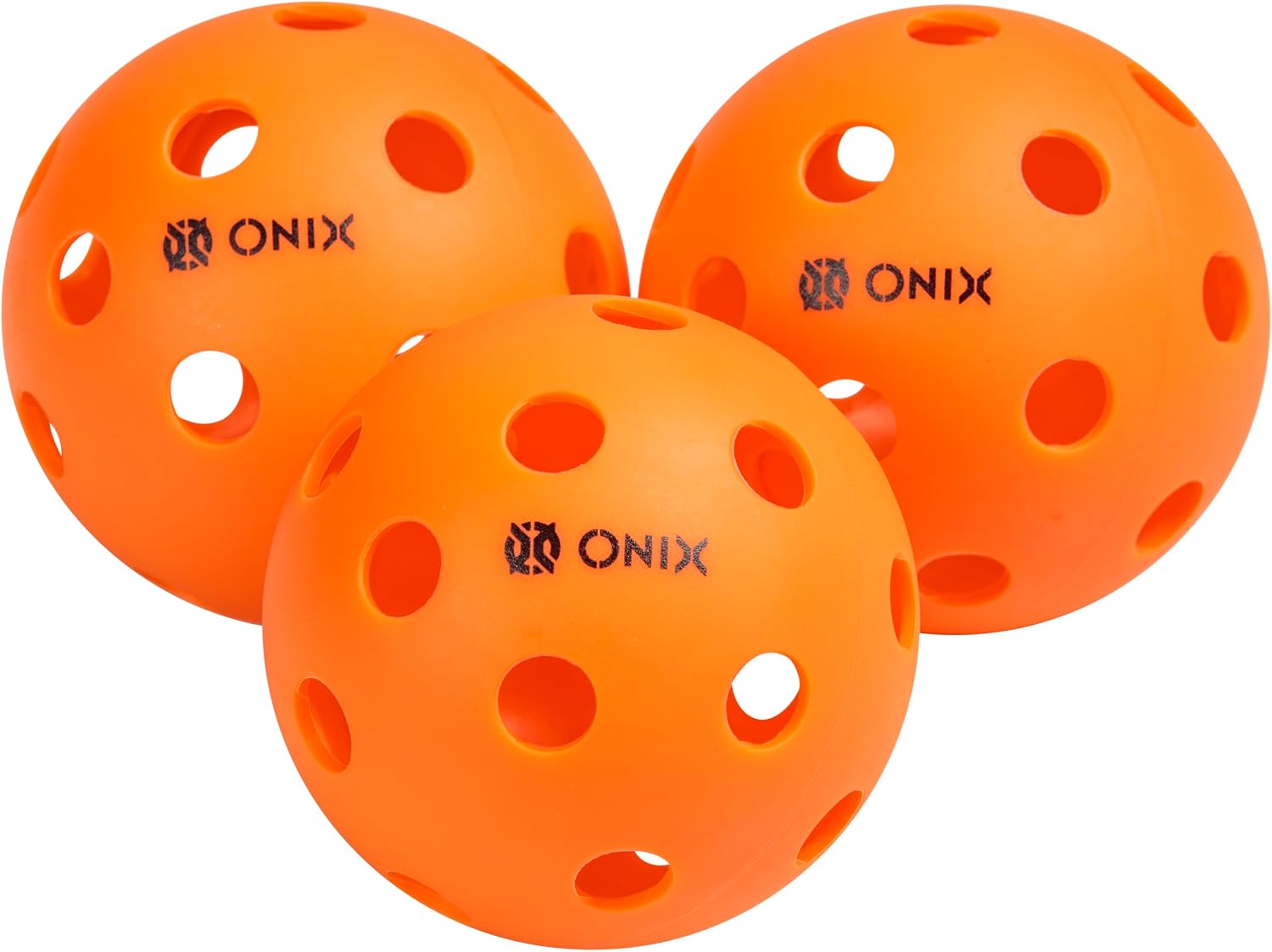
The Recruit line is Onix's ready-to-play, budget-friendly entry into indoor balls, and it over-delivers for the price: seam-welded construction that resists cracking, a precision-drilled hole pattern for consistent flight, and a sub-$10 price tag that makes it easy to keep several packs in the bag. It is not the ball you will see at a sanctioned tournament, but for casual indoor games, practice sessions, and players just getting into the sport, it is hard to beat.
Pros
- Ready to play out of the box with no break-in needed
- Seam-welded construction resists cracking during hard rallies
- Consistent bounce and flight on indoor gym and hardwood surfaces
- Budget-friendly price makes it easy to stock several packs
Cons
- Not built for sanctioned tournament play, league players should stick with a USAPA-approved ball
- Only comes in a 3-pack, so you will be reordering sooner than a 6-pack
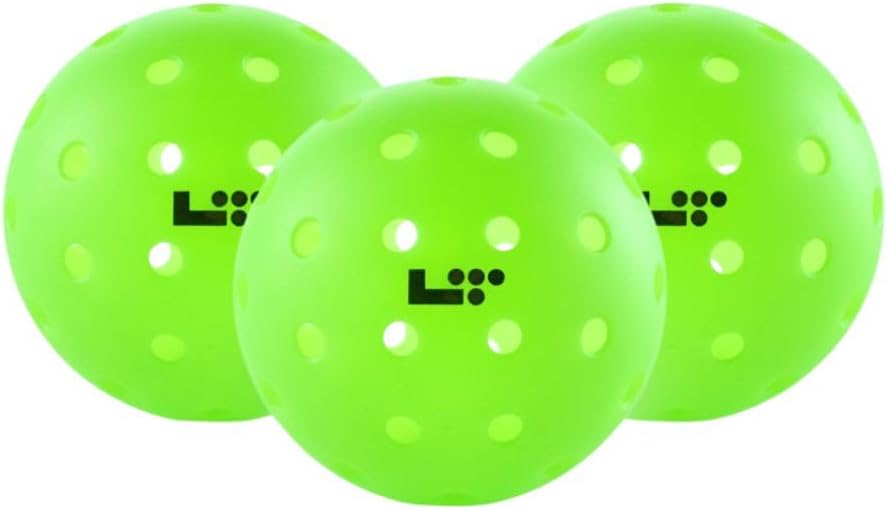
The LT Pro 48 is the official ball of the PPA Tour, the same tour the pros actually compete on, and it plays like it. A 48-hole two-piece design, more holes than any other outdoor ball in this roundup, keeps flight noticeably true and consistent even in hard, fast exchanges. It costs more than a standard bulk pack, but players who switch report it holds its shape and roundness through a full season in a way softer outdoor balls do not. If you want the exact ball tour pros play with rather than just a tournament-approved one, this is it.
Pros
- Official ball of the PPA Tour, the same ball pros compete with
- 48-hole design, more holes than any other ball in this roundup, for exceptionally consistent flight
- Durable 2-piece construction that resists cracking in hot and cold weather
- High-visibility neon green stays easy to track in play
Cons
- Most expensive ball in this roundup by a wide margin
- Firmer, faster feel takes adjustment if you are used to softer balls like the Franklin X-40
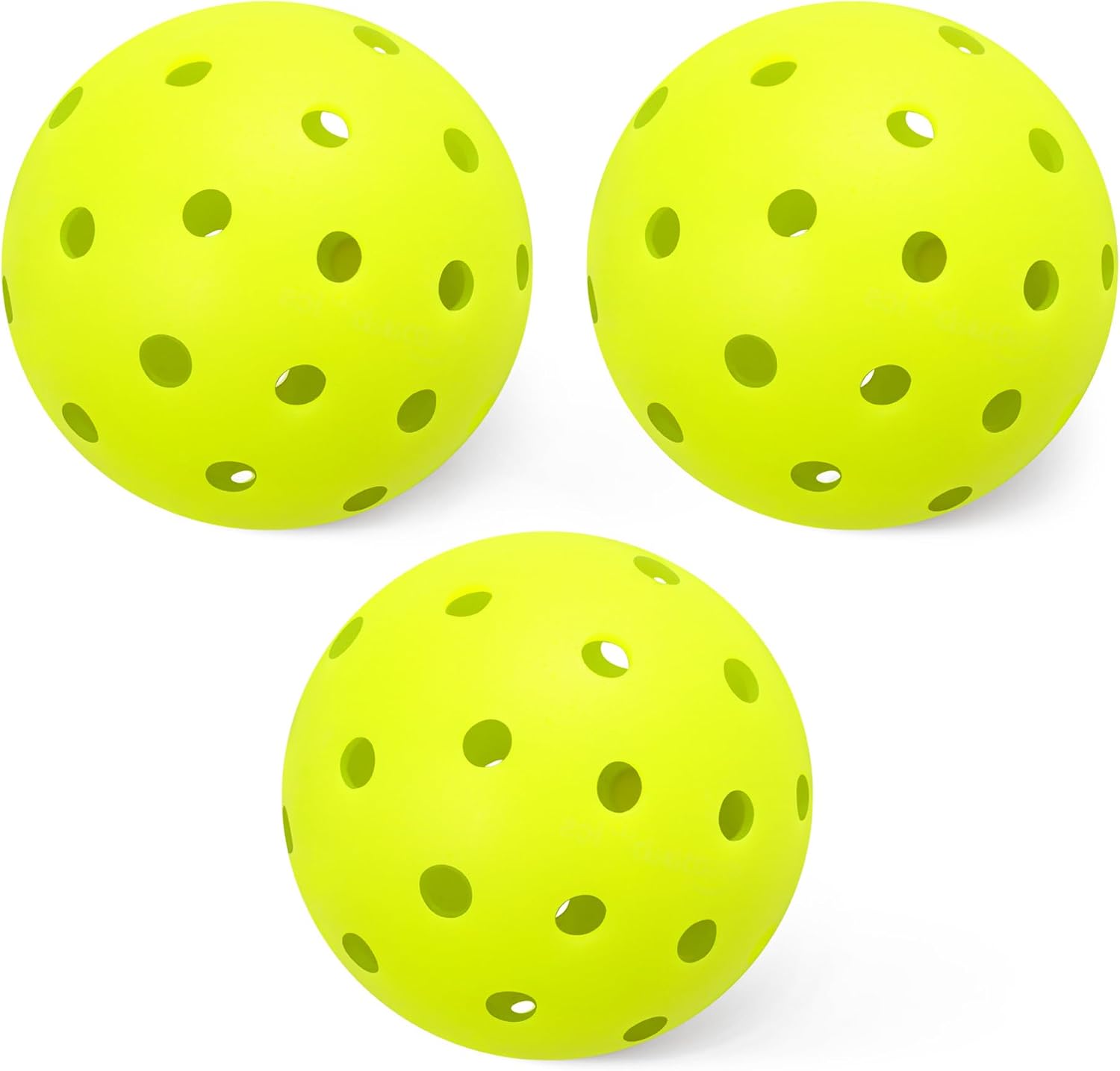
Not every player needs a $50 tour ball to practice with, and the Amazon Basics Outdoor is proof: a USAPA approved, 40-hole outdoor ball that undercuts every other outdoor option in this roundup on price while still holding up to regular court time. It is not going to show up at a sanctioned tournament, but for casual outdoor play, drilling, and backyard games where you just need a reliable ball without overthinking it, this is the one to grab.
Pros
- Lowest per-ball price of any outdoor option in this roundup
- USAPA approved 40-hole design for balanced outdoor flight
- High-visibility yellow makes the ball easy to track in play
- Backed by a trusted, widely-reviewed retail brand
Cons
- Not the ball you will see at a sanctioned tournament
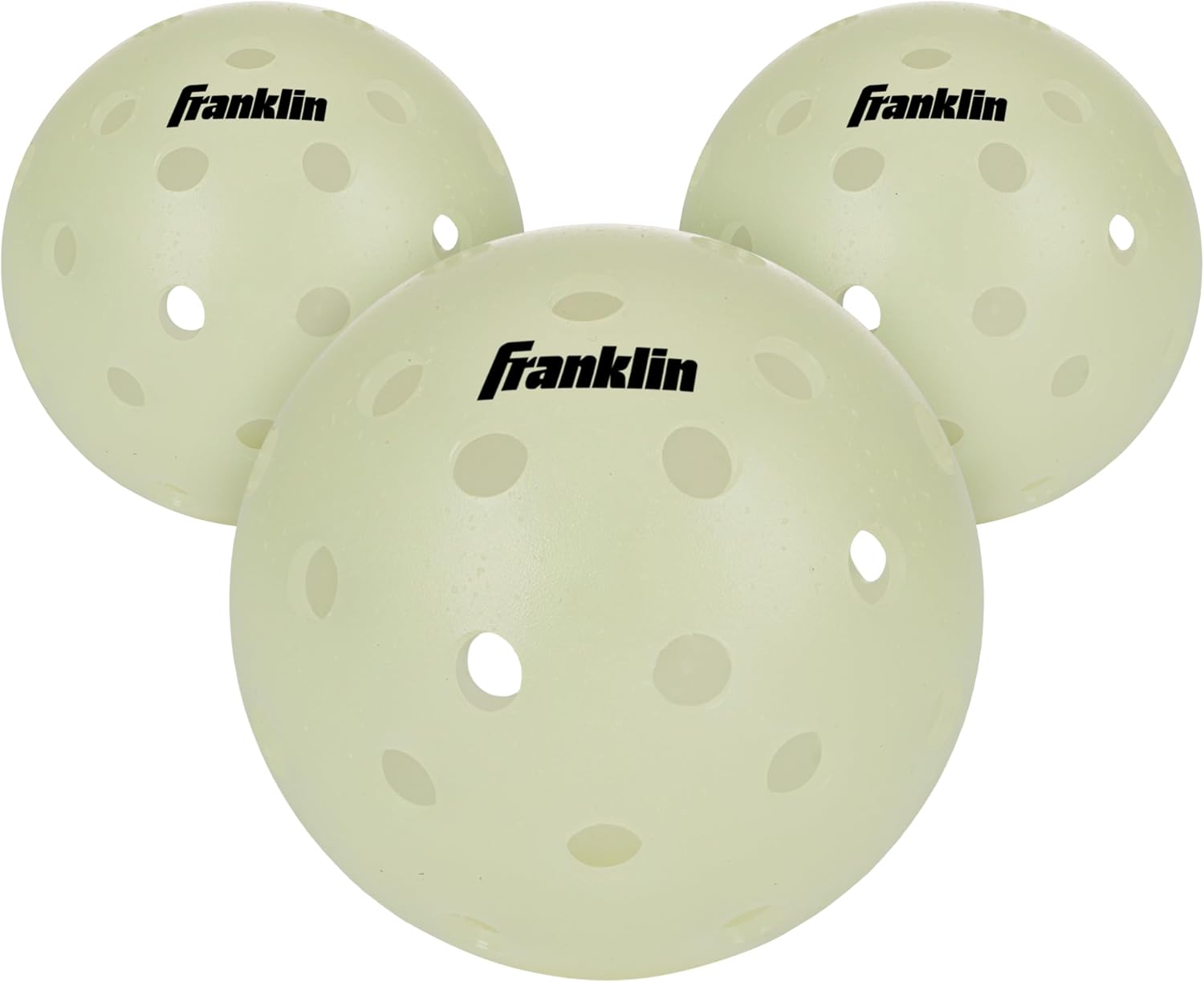
The Glow in the Dark ball solves a problem no other ball in this roundup does: what to do once the sun goes down mid-session. Charge it under sunlight or an indoor lamp for about 15 minutes and it glows bright enough to keep a rally going after dark, and it is built using the same manufacturing process as Franklin's own X-40 tournament ball. It will not replace a USAPA-approved ball for league night, but for backyard games, late practice, and simply stretching the evening a little longer, it is the easiest way to keep playing once the lights would otherwise end the game.
Pros
- Built using the same manufacturing process as Franklin's official X-40 outdoor ball
- Charges bright in about 15 minutes under sunlight or an indoor light, no batteries needed
- Regulation 26g / 74mm size and weight, so it plays like a normal outdoor ball once it glows
Cons
- Not USAPA approved or rated for competitive or tournament play, rec and backyard use only
- Glow fades over a session and needs a fresh charge under light to stay bright
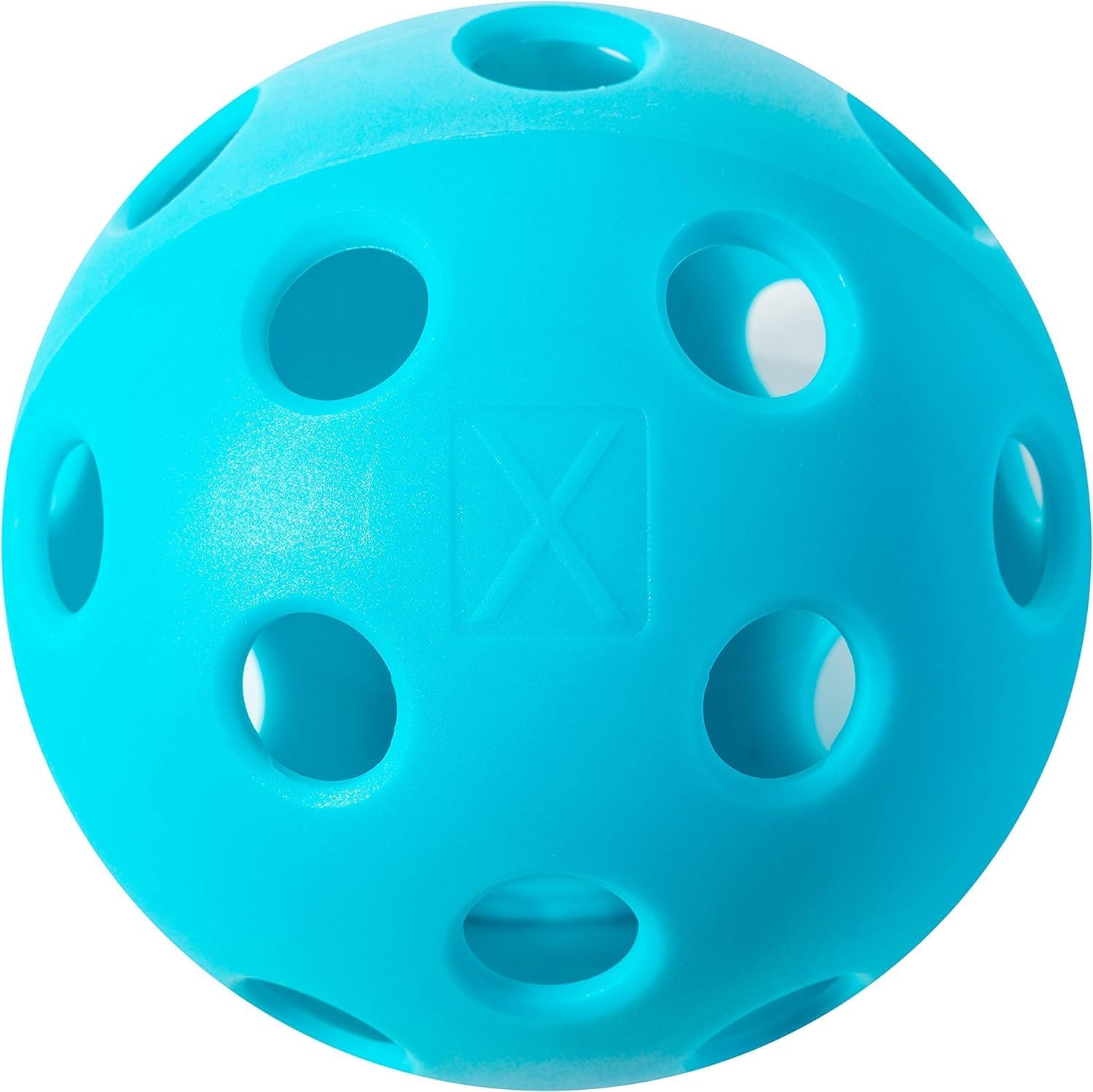
The Photon is not the only indoor ball worth owning, and the X-26 is why: same 26-hole, USAPA-approved indoor construction, but from Franklin's two-piece build with a distinct blue or lime green color that a lot of players track more easily against a gym floor than orange or yellow. It plays a touch firmer than the Photon, which some indoor groups prefer, and comes with a storage tube for a court bag.
Pros
- USAPA approved for indoor tournament play
- Blue and lime green colorways stand out better than orange on some gym floors
- Two-piece construction backed by a widely trusted brand
- Comes with a storage tube useful for a court bag
Cons
- Some balls show a mold seam that can affect bounce on a direct hit
- Softer feel than an outdoor ball, so durability varies with how hard a group plays
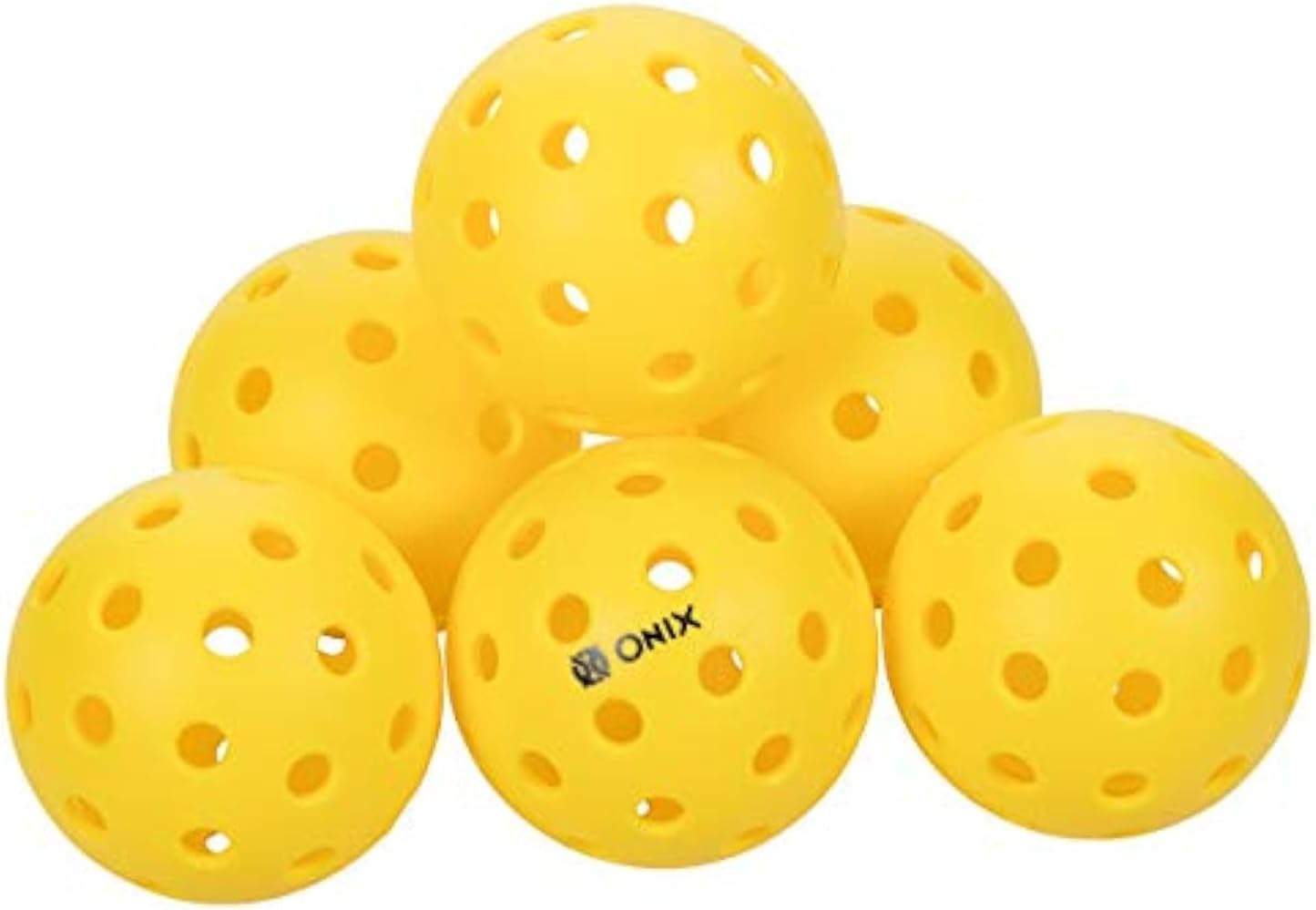
Wind is the one outdoor variable no player controls, and the Pure 2 is built specifically for it. Onix weighted the ball heavier than a standard outdoor pickleball so it holds a straighter line in gusty conditions instead of ballooning off course, using the same True Flight Technology found across the Onix lineup. Exceptional seam welding backs it up with above-average durability, and Authentic Bounce Technology keeps the rebound predictable shot after shot, so a ball that plays true on a calm morning still plays true once the wind picks up.
Pros
- Weighted construction designed to fly straighter and resist wind drift on gusty outdoor courts
- Exceptional seam welding for above-average durability against a standard outdoor ball
- Authentic Bounce Technology keeps rebound and flight consistent shot after shot
Cons
- Listing does not carry an explicit USAPA tournament-approval claim, league players should confirm sanctioning before relying on it for official play
- Costs more per ball than a straightforward bulk-pack option like the GoSports GS 40
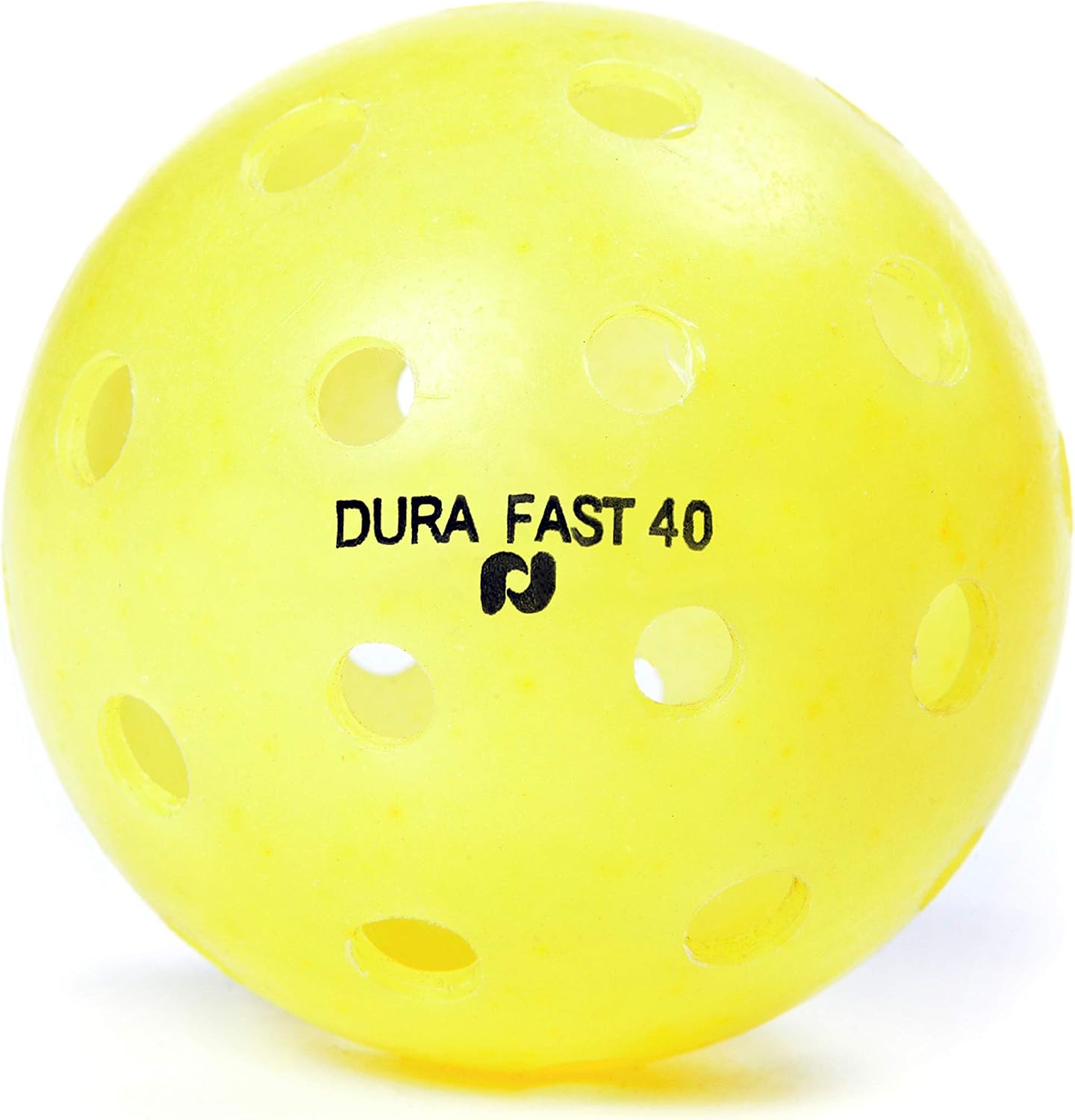
The Dura Fast 40 comes from Pickleball Inc., the original company behind the sport, and it is the ball that shows up most often at sanctioned tournaments once players move past casual league play. One-piece rotationally molded construction with 40 precisely drilled holes gives it a harder, faster flight than a softer outdoor ball, the kind of true, predictable bounce competitive players specifically look for once they have outgrown a beginner-friendly ball. It plays faster and less forgiving than the Franklin X-40, which is exactly why serious players reach for it once shot placement matters more than shot mercy.
Pros
- USAPA/IFP approved and widely used at sanctioned tournaments
- One-piece rotationally molded build with smooth, consistent seams
- Hard, true flight that rewards precise shot placement
Cons
- Cracks faster than a softer ball like the Franklin X-40, expect roughly 3-10 games in harsh conditions
- Harder, faster feel is less forgiving for beginners or casual players
- Costs more per ball than a bulk-pack option like the GoSports GS 40
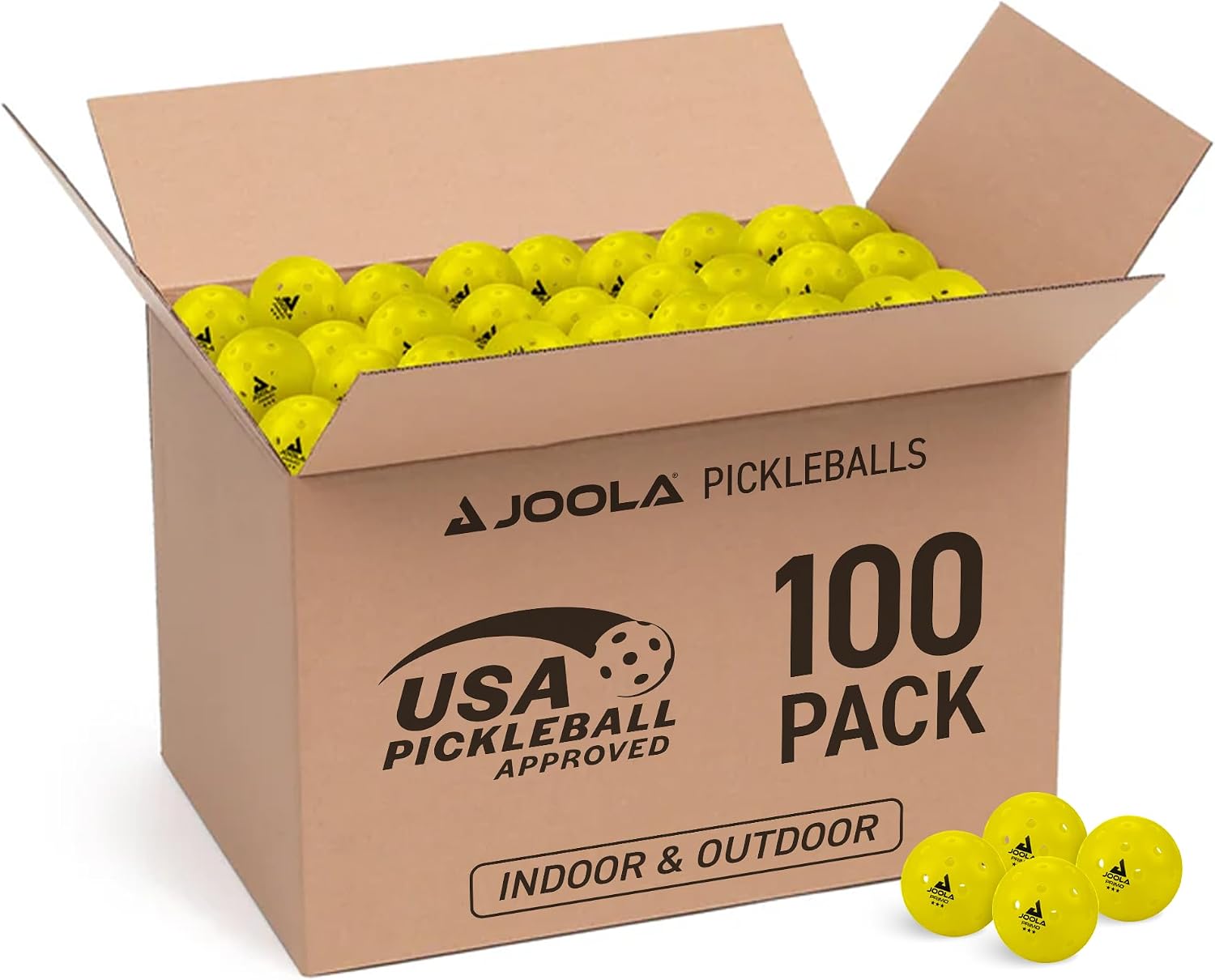
Every outdoor ball in this roundup gets softer, or outright cracks, once the temperature drops, and that is the problem the Primo solves. Its rotationally molded polyethylene shell is formulated to naturally harden in cold air instead of going brittle, so it holds its shape and bounce through a late-fall or winter session that would crack a warm-weather ball within a game or two. JOOLA sells it in a 100-ball case, which suits exactly the player this pick is for: someone stocking up for a cold-climate season rather than replacing a sleeve of three balls every few weeks.
Pros
- Rotomolded polyethylene shell formulated to resist cracking in cold weather, where most outdoor balls fail fastest
- USAPA approved and rated for tournament and recreational play indoors or outdoors
- 40 precision-drilled holes for a predictable, wind-resistant trajectory
- Sold in a 100-ball case, enough for a full winter league season without reordering
Cons
- Plays noticeably softer than a ball like the Franklin X-40 once temperatures climb back into the 70s and above
- The 100-ball case is a bigger upfront cost than a standard sleeve, not a fit for someone who just wants a few backups
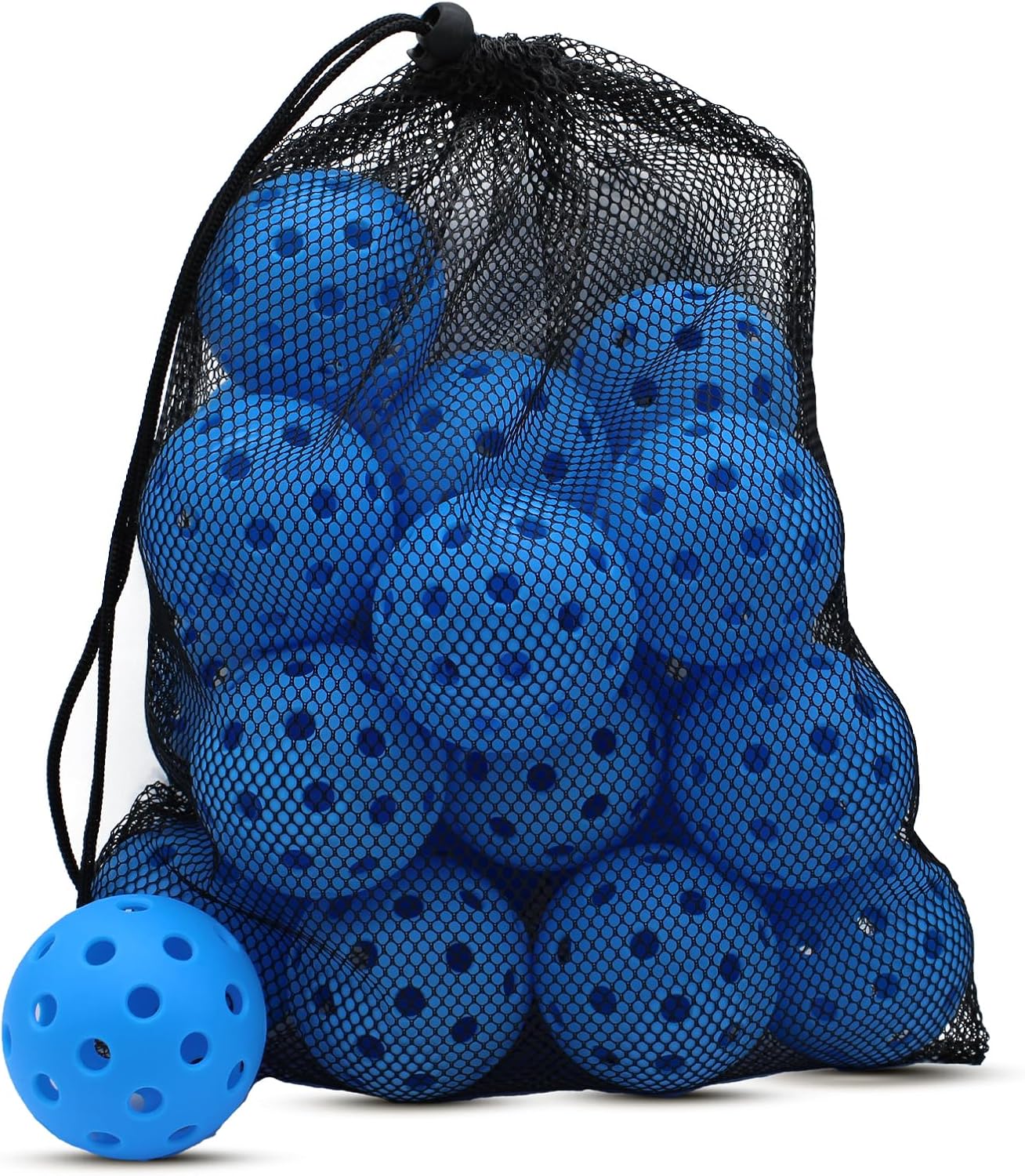
Not every pickleball needs to be made from virgin plastic, and the Magicorange Recycled is proof a ball built with recycled material can still hold up on outdoor courts. It carries Global Recycled Standard certification for its recycled content, safer chemical processing, and fair worker conditions, credentials none of the other balls in this roundup can claim. Forty precision-drilled holes and a seamless build keep flight and bounce consistent, so going greener does not mean giving up performance, and it scales from a small starter pack up to a 100-ball case for a full club supply.
Pros
- Global Recycled Standard certified for recycled content, safer chemicals, and worker well-being, unmatched by any other ball in this roundup
- USAPA-approved 40-hole design with consistent bounce and balanced flight
- Seven vibrant color options for high visibility on outdoor courts
- Sold in pack sizes from 6 up to 100, scaling from a starter set to a full club supply
Cons
- Not the ball you will see at a sanctioned tournament
- Some players notice a slightly softer feel than a harder virgin-plastic ball like the Dura Fast 40
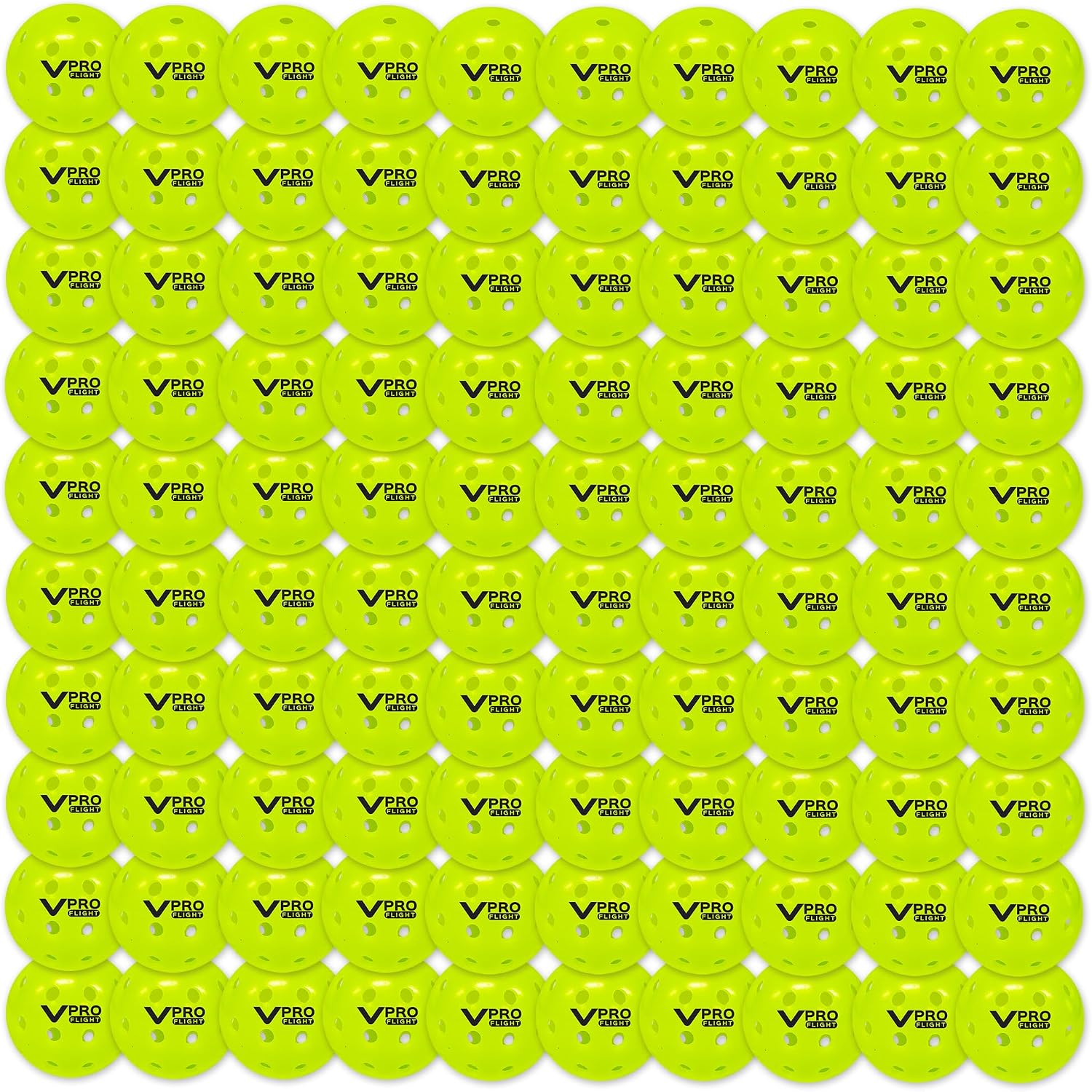
None of the other balls in this roundup are sold specifically with ball machines and club-level volume in mind, and the VPRO Flight is built for exactly that: a Gen 2 resin formula engineered to hold its bounce through the kind of repeated feeding a machine or a busy club court puts a ball through, sold in 3, 6, 12, 36, and 100-ball packs so a coach or club can buy once and stop reordering sleeves. It carries the same USAPA approval and 40-hole design as the tournament balls above, it is just packaged and engineered for people burning through hundreds of balls a week instead of a dozen.
Pros
- Sold in 3 through 100-ball packs, built to scale from a fresh sleeve to full ball-machine hoppers
- Gen 2 resin blend engineered to hold bounce and shape through heavy repeated use
- USAPA approved and the official ball of The Picklr, the nation's largest indoor club network
- Hi-vis color stays easy to track after hundreds of feeds through a machine
Cons
- Noticeably more expensive per ball than a bulk option like the Franklin X-40 or GoSports GS 40
- Buy a small pack first if you play daily, since longevity can vary
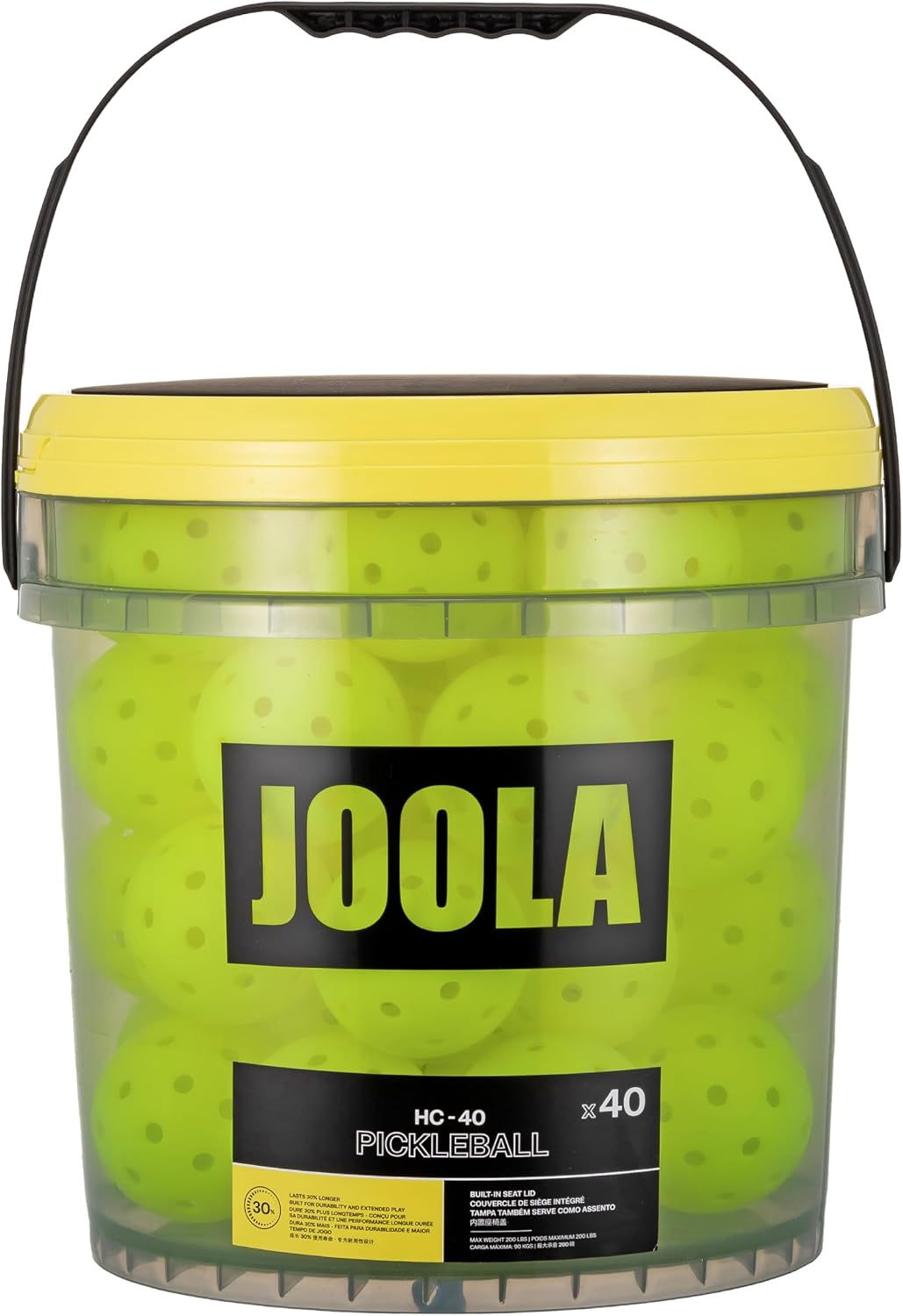
The HC-40 is JOOLA's answer for players who want the exact ball a top pro trains with rather than just a tournament-approved one: it is the official ball choice of Ben Johns, the sport's reigning world No. 1, and the equidistant 40-hole spacing is engineered specifically for consistent flight and true bounce shot after shot. A proprietary polymer blend and seamless one-piece build hold their shape through hard outdoor play, and it scales from a 3-ball sleeve up to a 100-ball case with a storage tube included, so a serious player can standardize on one ball for practice and match play alike.
Pros
- Official ball choice of Ben Johns, the world No. 1, for training and match play
- Equidistant 40-hole spacing engineered for consistent flight and true bounce
- Durable proprietary polymer blend and seamless build hold their shape over time
- Scales from a 3-ball sleeve to a 100-ball case with a storage tube included
Cons
- Costs more per ball than a straightforward bulk option like the GoSports GS 40
- Try it on your own surface, since indoor/outdoor balls can play differently on each
- No per-ball discount until the largest case size, unlike bulk packs that get cheaper per ball as you size up
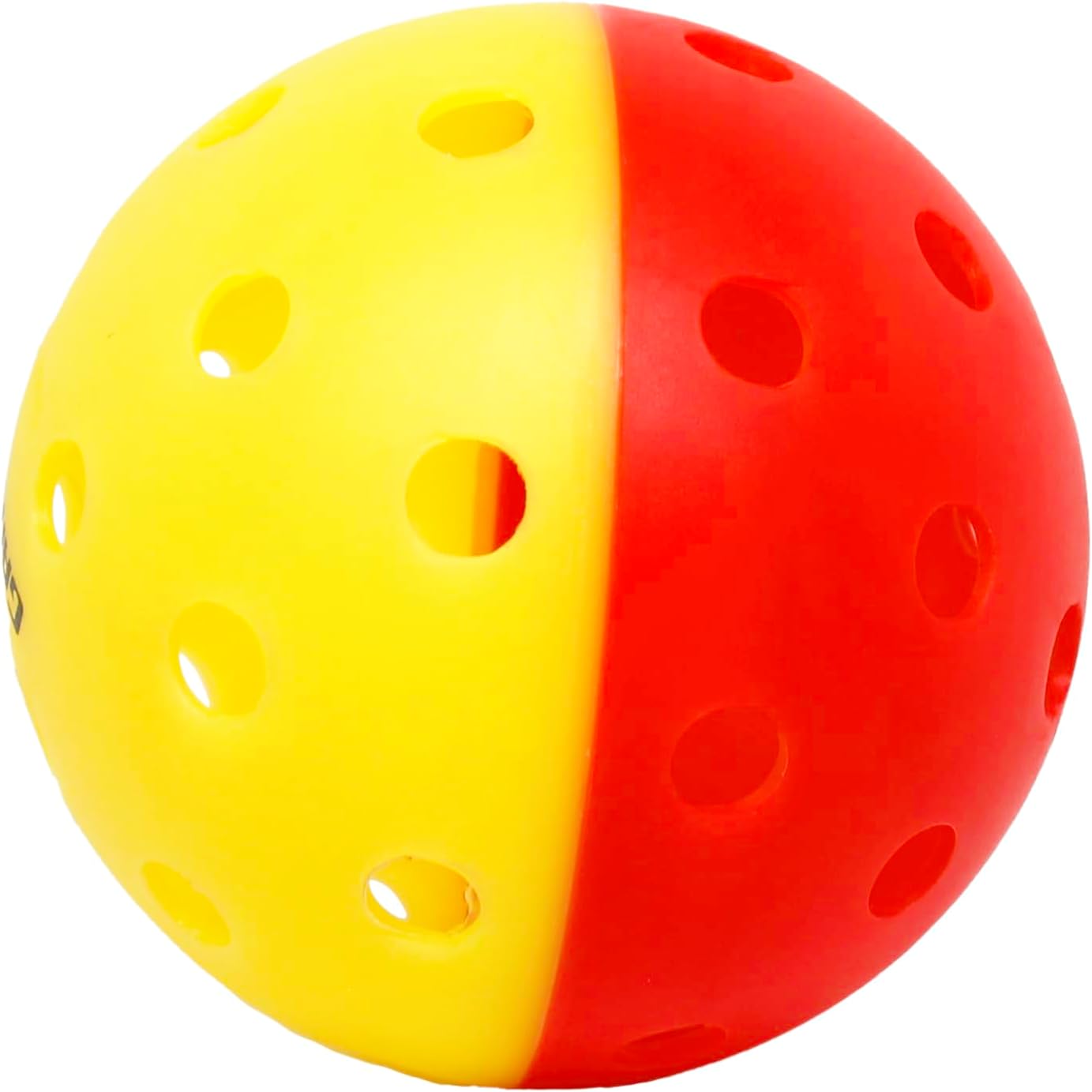
None of the other balls in this roundup are built to help you actually see what your paddle is doing to the ball, and that is the specific problem the GAMMA Two-Tone Training Ball solves. A yellow and red split-color design makes rotation immediately visible in flight, turning an abstract feel like "more spin" into something a player or coach can watch happen shot after shot. It still plays close to a standard outdoor pickleball, 40 precision-molded holes and a consistent bounce, so switching to it for a training session does not mean sacrificing realistic flight. It is not built for sanctioned play, but for drilling topspin serves, dinks, and slices with a coach or practice partner, it earns a spot in the bag none of the tournament-focused balls above can fill.
Pros
- Two-tone yellow and red split face makes spin instantly visible during drills and rallies
- Sold in 3, 6, and 12-packs so players can buy exactly the volume they need for practice or club use
- Backed by GAMMA, an established racquet-sports brand with a large tennis and pickleball catalog
Cons
- Not USAPA-sanctioned for tournament play, built specifically as a training aid
- Compare it with a dedicated outdoor ball like the Franklin X-40 if you mostly play outside
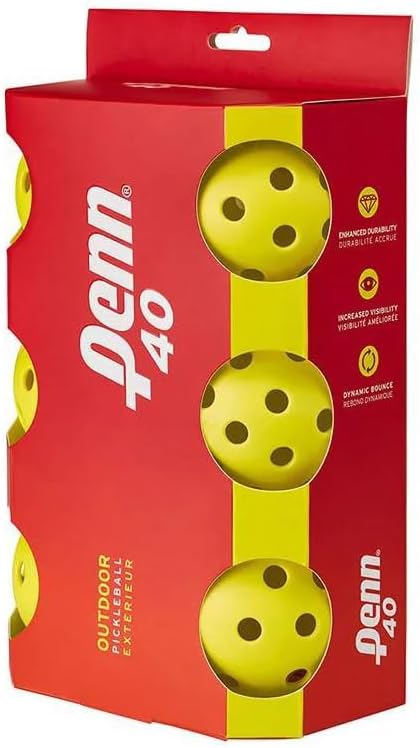
Most tournament-style outdoor balls in this roundup are built to be hard and fast, and that is exactly what some recreational players do not want. The Penn 40 is the gentler alternative: a USAPA approved, 40-hole outdoor ball from a racquet-sports name most players already trust, tuned for a softer, more forgiving bounce that is easy on the paddle and the wrist. It still holds its shape through weeks of regular play, and the bright yellow shell stays easy to pick out against a court surface. For club nights, rec leagues, and anyone who finds a ball like the Dura Fast 40 too punishing, it is the one to try first.
Pros
- USAPA approved, so it is legal for sanctioned play despite the softer feel
- Gentler, more forgiving bounce than a harder tournament ball like the Dura Fast 40
- 40 precision-drilled holes for consistent outdoor flight, including on breezy days
- Bright yellow color stays easy to track in poor light
Cons
- Softer, slower feel does not suit players who want a hard, fast ball like the LT Pro 48
- Test the bounce across a sleeve, since balls can vary
- Costs more per ball than a bulk option like the GoSports GS 40
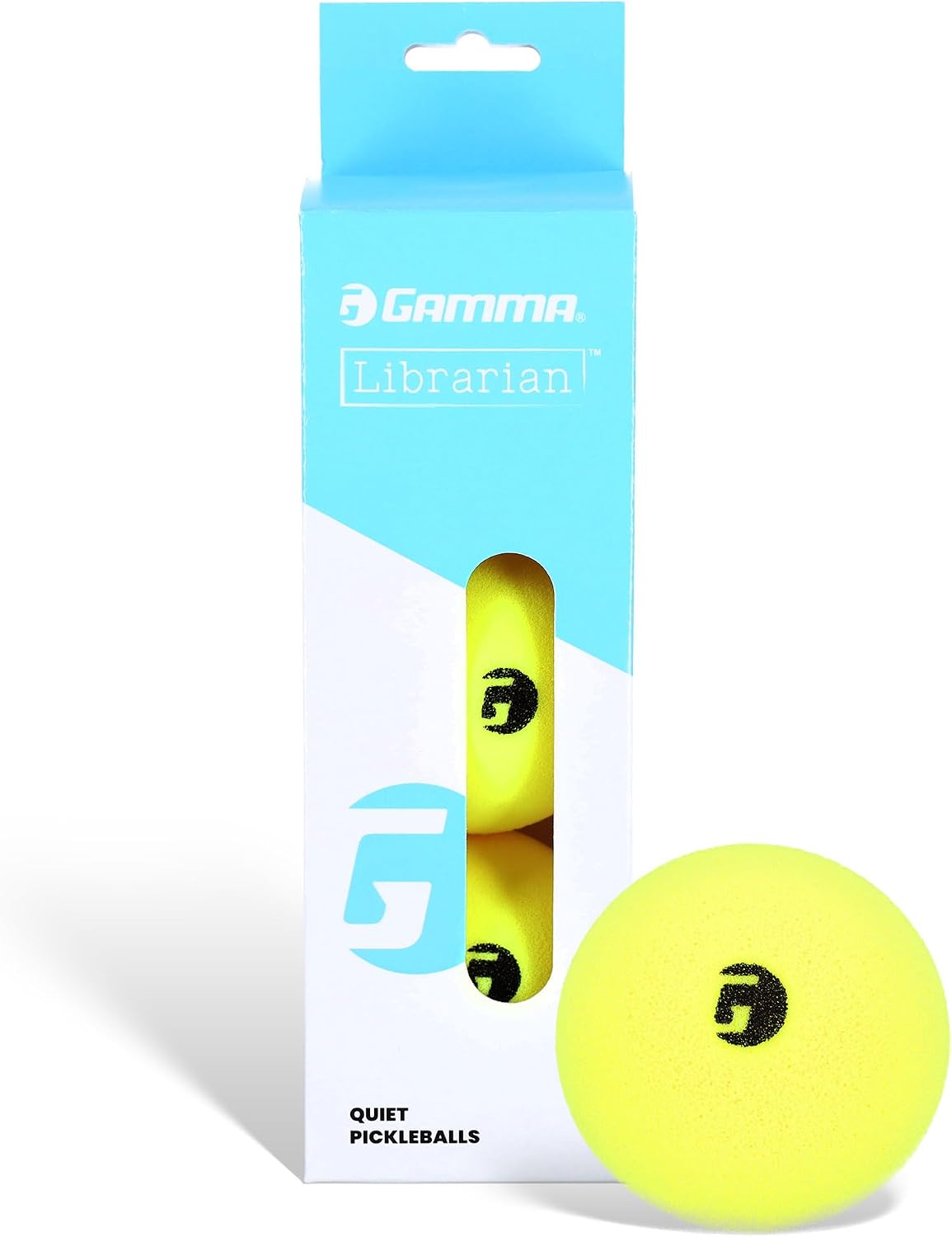
Noise is the number one reason courts get restricted, and every hard plastic ball in this roundup makes the same sharp pop. The GAMMA Librarian is the answer for HOA courts, shared driveways, garages, and basements: a solid foam ball rated at roughly 60 dB and certified in USA Pickleball's Quiet Category, with the same diameter and a regulation-range weight (about 24 g) as a standard ball. It plays on indoor and outdoor surfaces and comes in a bright yellow that is easy to track. It is not a tournament ball, but for drilling, wall work, and social play where the neighbors are listening, it is the one to get.
Pros
- Far quieter than any hard plastic ball, around 60 dB instead of a sharp pop
- Certified in USA Pickleball's Quiet Category, which matters for HOA and noise-restricted courts
- Same size and regulation-range weight as a standard ball, so the bounce feels familiar
- Works indoors and outdoors, including wall drills in a garage or basement
Cons
- Drives travel slower and spin bites less than on a hard ball like the Franklin X-40
- Foam can wear faster than rotomolded plastic, and outdoor use gets it dirty
- Costs more per ball than a bulk plastic option like the GoSports GS 40
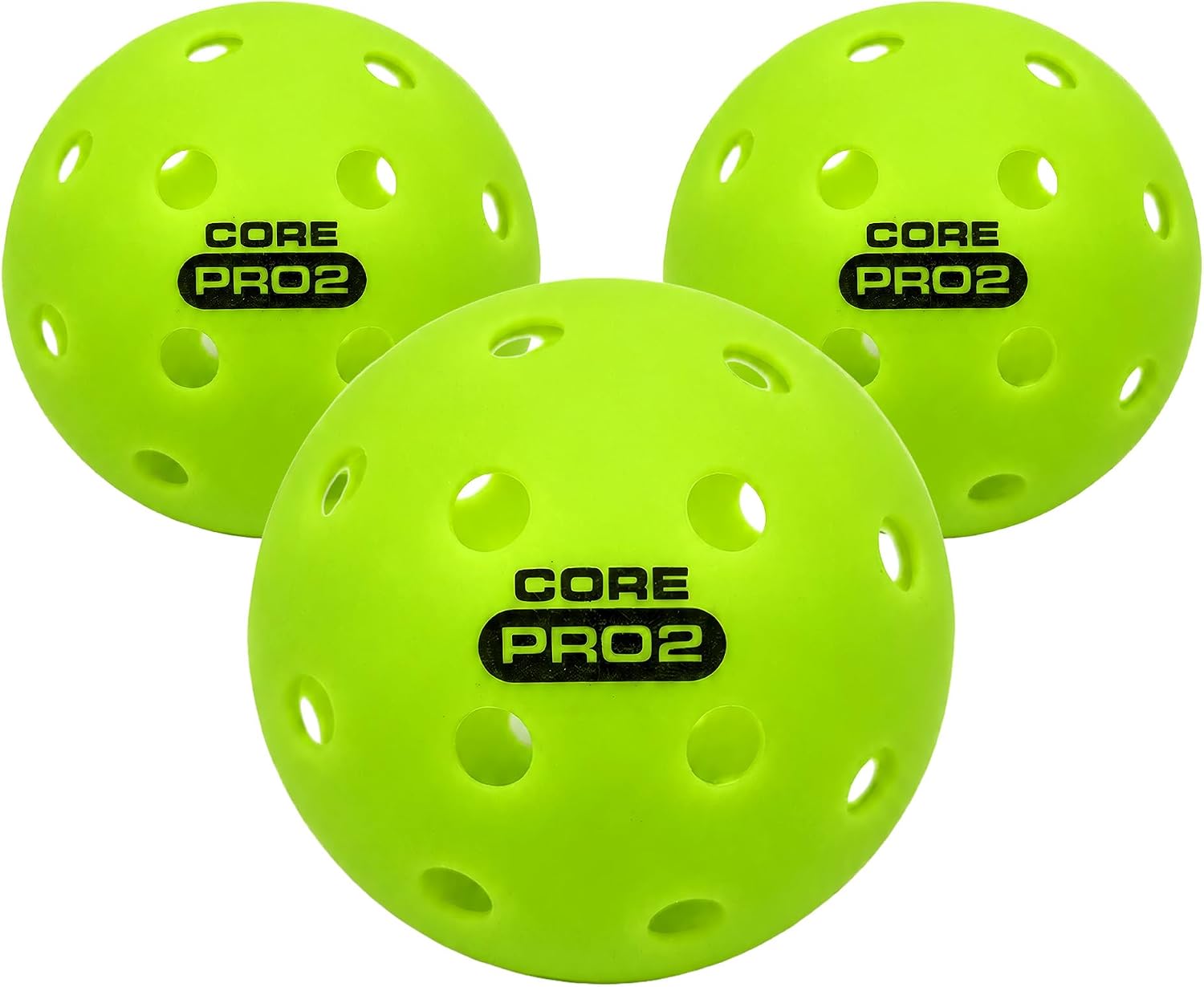
Every other outdoor ball in this roundup has a smooth shell. The CORE PRO2 is the one with a textured lime surface, and the point of it is feel: the slightly grippy skin gives more tactile contact off the paddle face, which shows up most on dinks, drops, and resets rather than on drives. It is a 40-hole, injection-molded outdoor ball built for asphalt and tennis-style hard courts, CORE batch-tests each production run for bounce, weight, and hardness, and the 3-pack sits around $10. It is the pick for a soft-game player who wants a ball that feels a little more connected than a slick X-40 style ball.
Pros
- Textured surface adds tactile feedback on dinks, drops, and resets
- Consistent, true bounce on outdoor hard courts with stable 40-hole flight
- Low entry price, with 3-pack and larger pack options
Cons
- Buy a small pack first, since durability can vary
- The listing does not claim USA Pickleball approval, so check before using it for sanctioned events
- Texture is a matter of taste; players used to a smooth Franklin X-40 may find it feels different
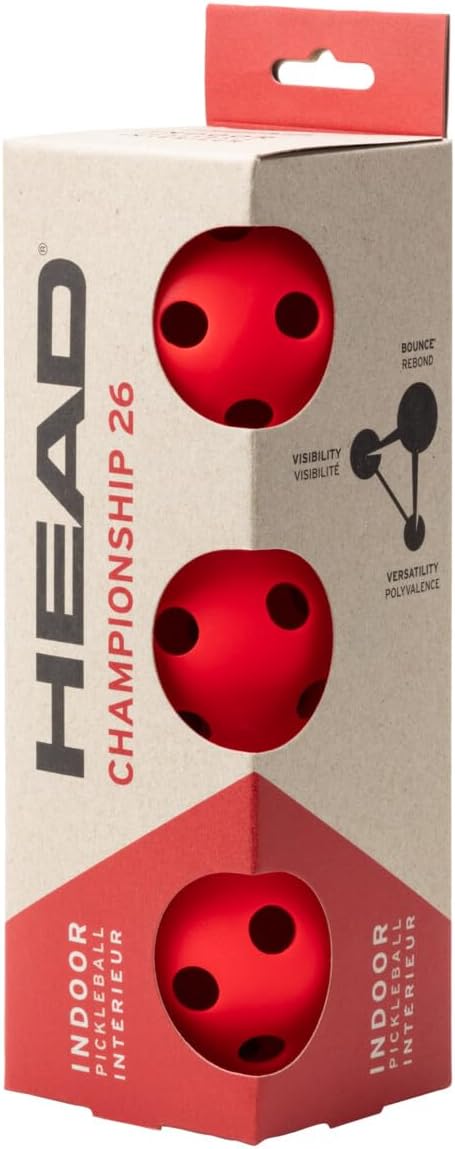
Yellow and orange balls are the indoor default, and on a honey-colored wood gym floor they can blend right into the boards. The HEAD Championship 26 is the red one: a 26-hole indoor ball tuned for wooden courts, with a softer, lower-skid bounce that keeps rallies predictable and a color that stands out against gym floors, bleachers, and dim overhead lighting. HEAD lists it as USA Pickleball approved, it comes in a 3-pack around $9 or a 100-pack for clubs, and it is the pick for indoor league and winter-gym players who keep losing sight of the ball mid-rally.
Pros
- Red shell is easier to track than yellow or orange on wood floors and under gym lighting
- 26-hole design with a true, low-skid bounce made for indoor wooden courts
- Softer feel that rewards control on dinks and resets
- Low 3-pack price, plus a 100-pack for clubs and teaching pros
Cons
- Buy a small pack first if you need balls that stay firm
- Indoor only; it plays slow and can drift on outdoor courts or in wind
- Bounce runs low on some multisport PVC floors, so it is best on true wood
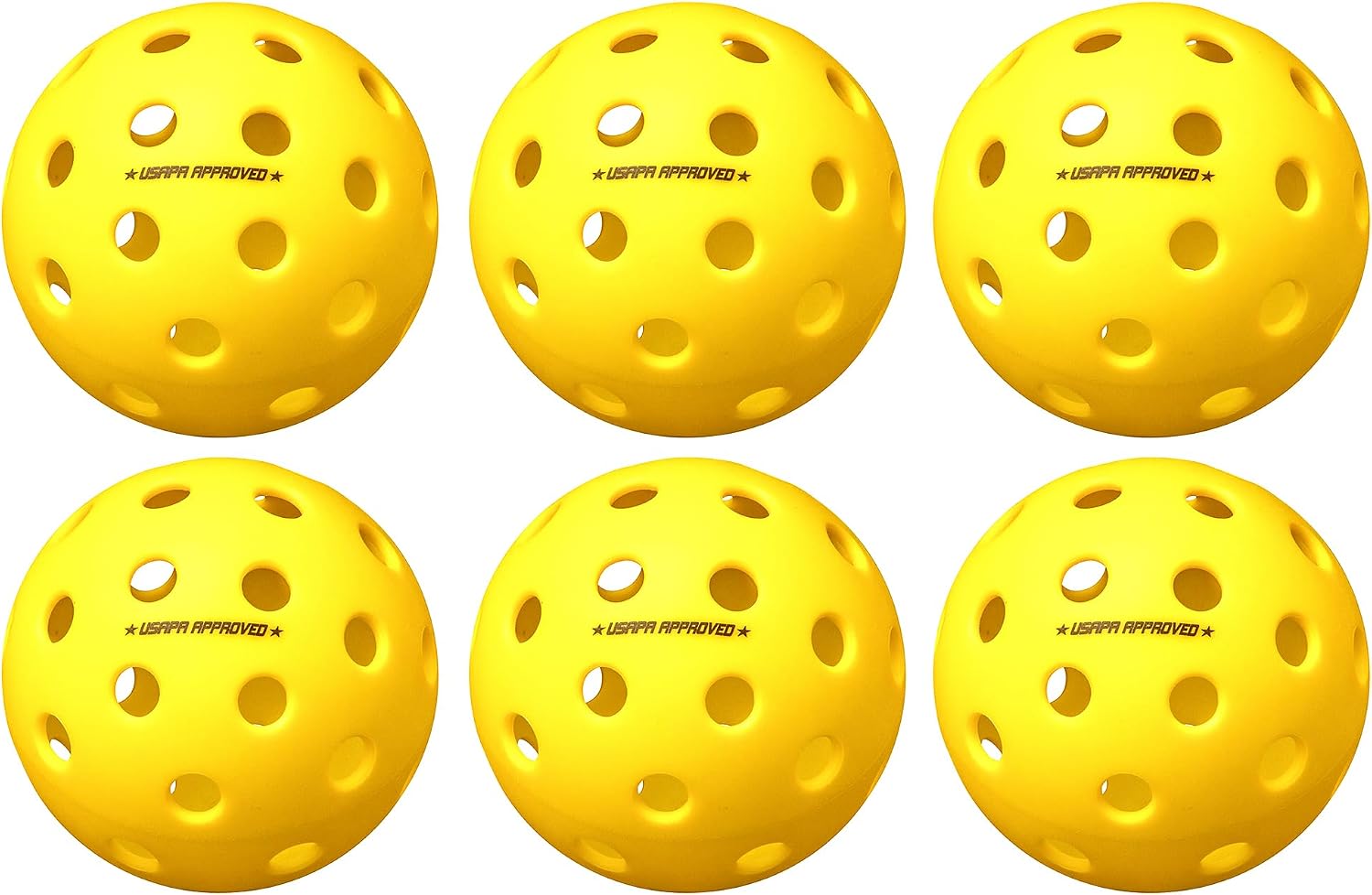
The Fuse G2 has been a fixture on outdoor courts and club ball bins for years, and it is still one of the safest outdoor buys for regular players. It is a 40-hole, USA Pickleball approved outdoor ball with welded seams built to resist splitting, small precision-drilled holes that help it hold a line in a breeze, and a true, predictable bounce on hard courts. Where the Onix Pure 2 is our pick for windy days, the Fuse G2 is the everyday outdoor ball: around $17 for a 6-pack, with 3-pack and 100-pack sizes for clubs, and a good in-stock alternative when the tournament favorites are hard to find.
Pros
- Welded seams resist splitting better than most budget outdoor balls
- Consistent, true bounce on concrete and asphalt courts
- Small 40-hole layout keeps it steady in light wind
- USA Pickleball approved for outdoor tournament play, in 3, 6, and 100-packs
Cons
- Plays a little harder and livelier than softer balls like the Penn 40, so dinks take some touch
- Costs more per ball than bulk practice packs
- Like any hard outdoor ball, it can go out of round or crack faster in near-freezing weather
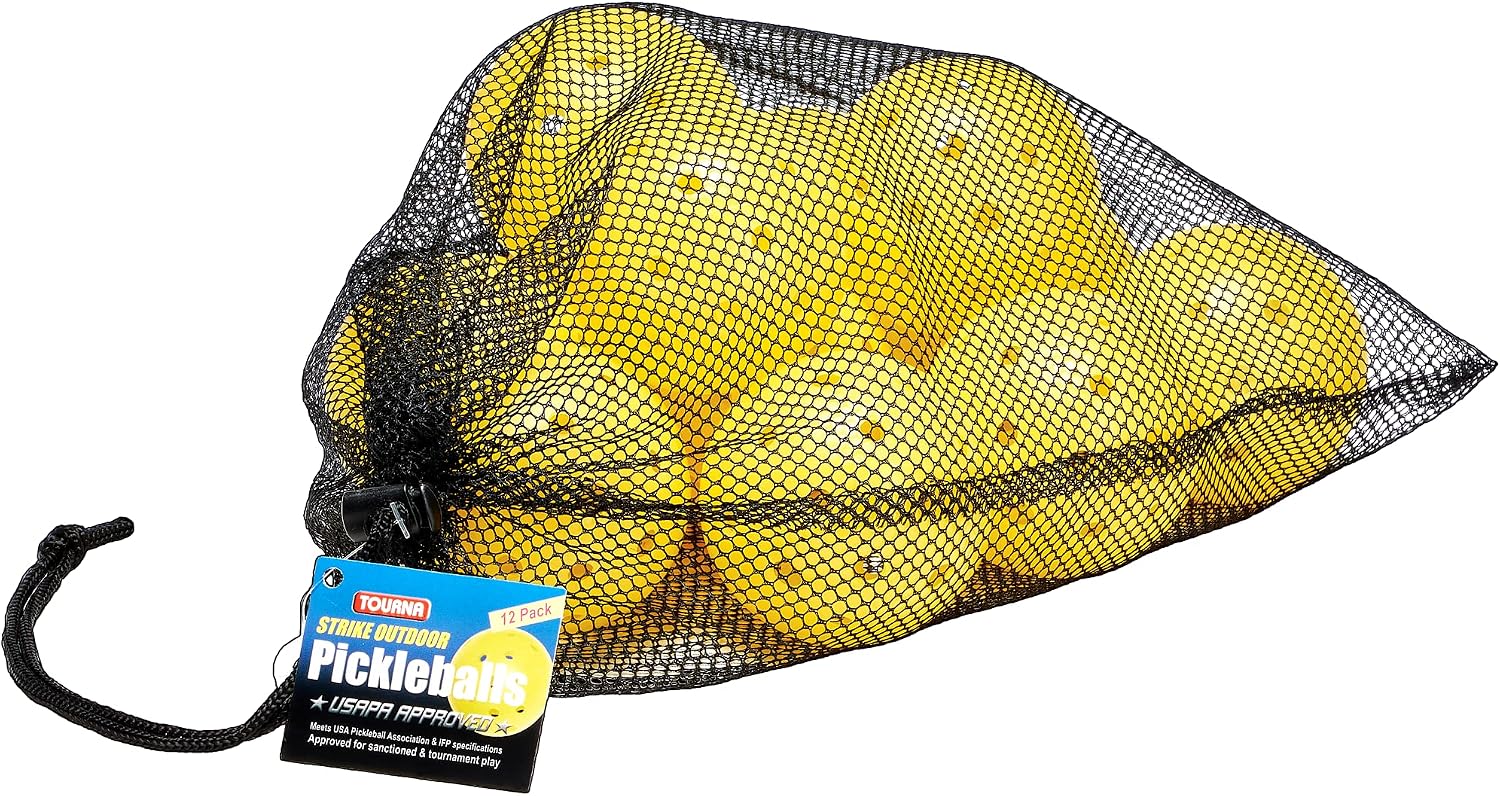
The Strike is the ball we point to when someone needs a full dozen of real, USA Pickleball approved outdoor balls without paying tournament-ball prices. You get 12 optic yellow, 40-hole balls (74mm, 24.5 grams) in a reusable drawstring mesh bag for around $11, which works out to under a dollar a ball. Tourna rates it at a mid-range hardness, so it bounces lively and true without the glassy, hard feel of the fastest tournament balls, and it is the official ball of Tyson McGuffin's signature camps. It is the easy restock for families, neighborhood groups, and weekly games that lose a few balls to fences and hedges every month.
Pros
- 12 USA Pickleball approved balls for roughly the price of a premium 3 or 4-pack
- Mid-range hardness gives a lively but forgiving bounce for mixed-skill groups
- 40 small drilled holes keep the flight steady in light wind
- Reusable mesh drawstring bag makes it easy to carry and store the whole dozen
Cons
- Not the ball most leagues and pro events standardize on, so tournament players should practice with their event ball
- Like most budget outdoor balls, it can crack or go out of round faster in cold weather
- Yellow only in this pack, which blends in on some green and yellow court surfaces
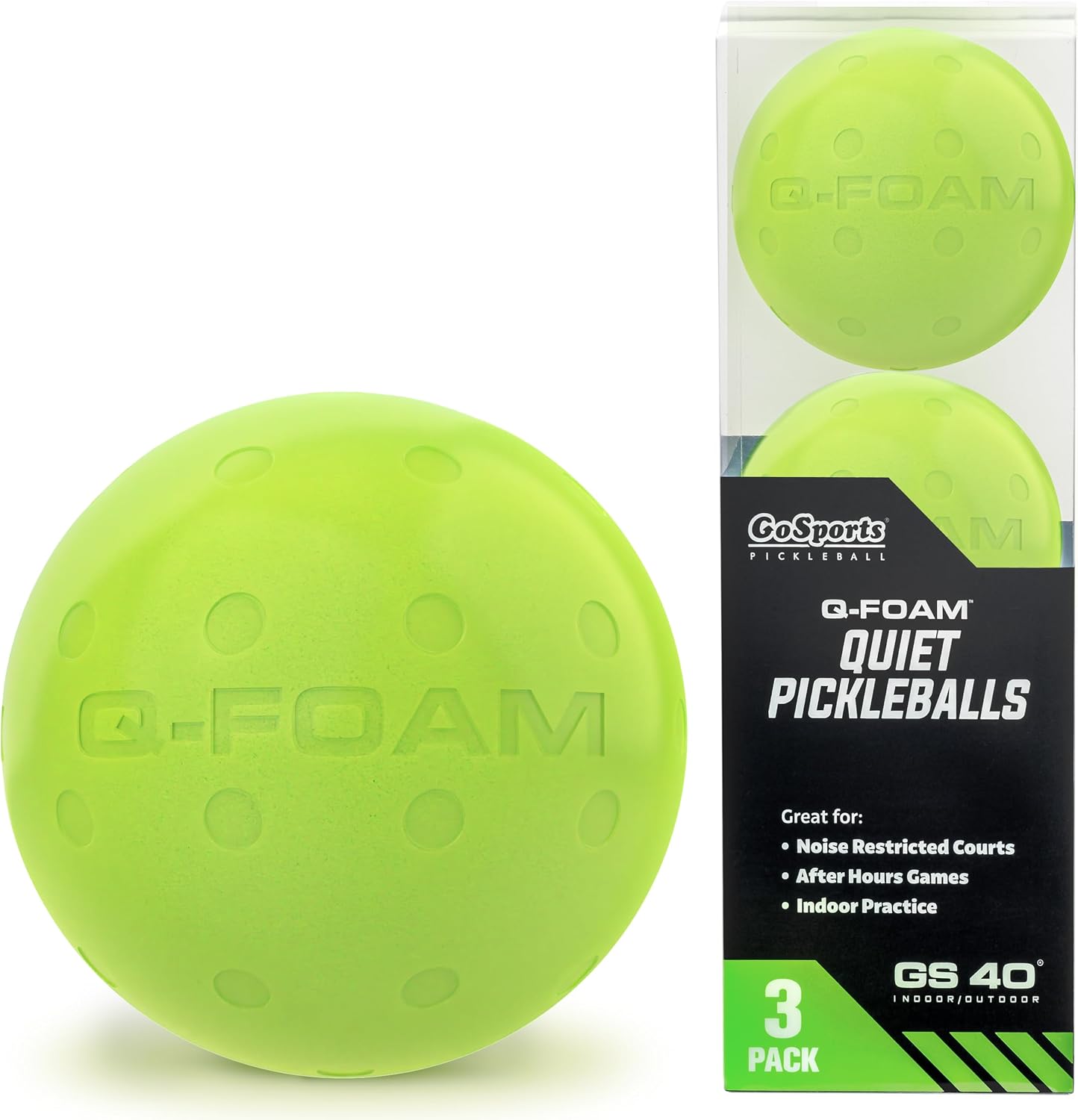
The Q-Foam is the cheaper way into quiet pickleball. GoSports molds it from a high-density foam at the standard 2.9 inch diameter and roughly 22 grams, with molded dimples where a plastic ball would have holes, so it looks and travels close to a real ball but lands with a dull thud instead of a pop. It is built for solo wall drills in a garage or basement, after-hours games, and noise-restricted neighborhood courts, and the soft foam takes the fear out of getting hit for beginners, seniors, and kids. Unlike the GAMMA Librarian, it is not certified in USA Pickleball's Quiet Category, so treat it as a practice ball rather than one your HOA court will officially sign off on.
Pros
- Lands with a soft thud instead of a sharp pop, so home and late-evening practice stays quiet
- Regulation 2.9 inch size and about 22 grams, so dinks and wall drills carry over to a real ball
- Soft foam does not mark walls or hurt on contact, which suits beginners, seniors, and kids
- Costs less per ball than most certified quiet balls and plays indoors or outdoors
Cons
- Bounces lower than a plastic ball, and drives and serves come off the paddle with less pop
- Not USA Pickleball approved or Quiet Category certified, so it is for practice and casual play only
- Foam picks up dents and scuffs after repeated outdoor sessions on rough asphalt
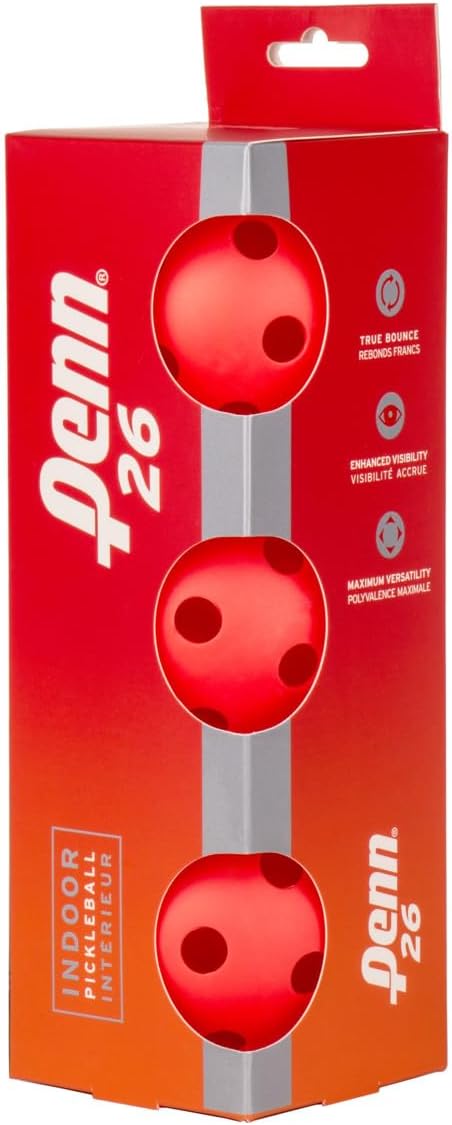
The Penn 26 is the indoor counterpart to the Penn 40 above: a 26-hole plastic ball with large, precision-drilled holes and a bright red-orange shell that stands out against wood gym floors and under fluorescent lighting. It plays a touch softer than harder indoor balls like the Onix Fuse, which slows rallies just enough that newer players can keep the ball in play while stronger players still get a clean, predictable flight. That makes it a natural fit for rec center open play and church or school gyms where skill levels mix on the same court. It comes as a 3-ball sleeve or a 100-ball bulk box for clubs.
Pros
- Red-orange color is easy to track against wood floors, gym walls, and fluorescent lighting
- Slightly softer feel slows the pace so beginners and stronger players can share a court
- Large 26-hole pattern gives the steady, floaty flight indoor play is built around
- Available in a 3-ball sleeve or a 100-ball box that drops the per-ball cost for clubs
Cons
- Durability is mixed: some sleeves stay lively for months, others crack early under hard drives
- Bounce can vary a little from ball to ball, which competitive players will notice
- Costs more per ball in the 3-pack than the HEAD Championship 26 or Franklin X-26
How to Choose a Pickleball Ball
Indoor and outdoor pickleballs are built differently, and using the wrong one changes how the game plays more than almost any other piece of gear.
Indoor vs. Outdoor Construction
Outdoor balls have 40 smaller, harder holes and a stiffer plastic built to resist wind and abrasive surfaces. Indoor balls have 26 larger holes and a softer compound tuned for smooth gym floors, playing slower and quieter than an outdoor ball would inside. Using an outdoor ball indoors plays too fast and too loud; using an indoor ball outdoors falls apart against rough asphalt.
USAPA Approval and Durability
Look for USA Pickleball (USAPA) approval if you play in leagues or want a ball that matches tournament conditions. Durability varies a lot by price tier: budget bulk packs are fine for practice and drilling, but balls that see rough outdoor courts regularly will crack faster than a premium tournament-grade ball.
Frequently Asked Questions
Can I use an outdoor ball indoors, or an indoor ball outdoors?
You can, but it plays worse. An outdoor ball indoors flies too fast and too loud for a gym floor, and an indoor ball outdoors wears out quickly against asphalt or concrete. Match the ball to the court you actually play on.
How many pickleballs should I keep on hand?
A dozen is a reasonable starting point for a regular player. Balls crack, get lost over fences, and wear out with play, so a bulk-pack option like the GoSports GS 40 is worth keeping around instead of running out mid-session.
Does the ball really matter as much as the paddle?
It matters differently. The paddle is about your own feel and control; the ball determines bounce, flight, and speed for everyone on the court, which is why leagues and tournaments standardize on a specific approved ball rather than leaving it up to whoever brought one that day.